

| Home |
| Biotech Programs |
| Careers |
| Internships |
| Resources |
| About SDBEC |
 |
'Where do
I go to get trained and how much education do I need for a job in
the biotechnology industry?' Some entry-level jobs exist for people who have only a high school diploma. However, most jobs require more education and training and in general, the better an individual is educated or trained, the more job opportunities will be available to them. San Diego students can choose to go to a community college, a four-year university or a school of continuing education for education and/or training. Education and training are both important; education is theoretical background and training is hands-on or practical experience. |
Community
Colleges
A student at one of San Diego's community colleges can earn a two-year
associate degree (A.A. or A.S.), which gives them a general educational
background and/or a certificate of completion in biotechnology. Community
colleges have open enrollment; however some courses may have prerequisites.
Certificate programs, which vary in focus and length, offer hands-on training
in the specialized techniques used in biotechnology. Students in certificate
program include high-school graduates, students with degrees, or working
professionals who want practical experience in a biotechnology laboratory
or manufacturing environment. Such experience is helpful to those who
want to enter the field, incumbent workers who want career advancement,
as well as those who want to transition from another career into biotechnology.
Many students begin their education at a community college and then transfer
to a four-year university. However, in many cases, an A.A. or an A.S.
or a certificate can qualify someone for certain entry-level jobs in the
industry.
 |
| San Diego Miramar College |
Four-year
Universities
San Diego is home to premier four-year universities. A student at a university
can earn his or her bachelors degree (B.A. or B.S.), or further their
education and training by earning graduate degrees (M.S., Ph.D.). Universities
require that students fulfill certain admission requirements. Graduates
with a bachelors or a graduate science degree and training are prepared
for a variety of job opportunities in the biotechnology industry. Graduates
of bachelor degree programs often find jobs as research assistants and
research associates, especially if they have a combination of theoretical
knowledge and hands-on laboratory training. Graduates of M.S. degree programs
typically have more experience and hands-on training and are employed
above entry level as research associates and research scientists. Graduates
of Ph.D. programs are usually qualified to be research scientists and
take on more management responsibility.
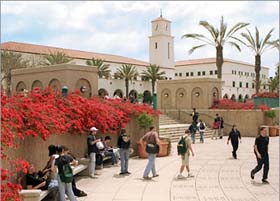 |
| San Diego State University |
Continuing
Education
Schools of continuing education, or extension programs, are sometimes
associated with a four- year university or can be free-standing organizations.
In either case, these schools do not have the rigorous admission application
required by the four-year universities. Schools of continuing education
provide post-baccalaureate courses, specialized training programs, certificates,
and workshops to the community. In general, these schools offer classes
to those who want to improve their existing job situation, transition
into different jobs, or gain personal enrichment. Students and professionals
in the biotechnology field can benefit in many ways from these programs.
 |
The San Diego Biotechnology Education Consortium (SDBEC) is a forum for the life sciences education community whose goal is to more closely align curriculum with industry need. SDBEC is part of the California Community Colleges “Doing What Matters for Jobs and the Economy” program.
For more information, please visit CalBiotechCareers.org.
© 2014 I Terms and Conditions